
 By
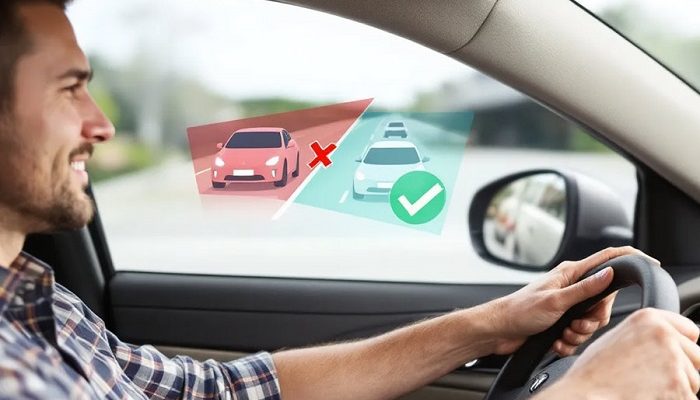
Every lane change on a multi-lane roadway is an exercise in split-second spatial geometry. At sixty-five miles per hour, a vehicle travels nearly one hundred feet every single second. In that fleeting window of time, merging into an adjacent lane without absolute certainty of what occupies that asphalt can result in a devastating sideswipe collision.
Modern vehicle architecture has unintentionally exacerbated this danger. While reinforced roof pillars and rising beltlines have dramatically improved rollover safety and crash test ratings, those thicker B- and C-pillars have created larger structural blind zones than ever before. Relying on casual glances and luck is a recipe for disaster. Cultivating disciplined blind spot awareness requires understanding vehicle geometry, dialing in mirror mechanics, and executing deliberate observation routines before every steering input.
Rethinking Mirror Geometry: Eliminating Redundancy
The vast majority of drivers adjust their mirrors incorrectly, creating massive artificial blind spots that do not need to exist. The standard instinct is to adjust the side mirrors until the driver can see the rear flank or door handles of their own car. While seeing your own sheet metal feels comforting, it creates useless visual redundancy. Your vehicle’s interior rearview mirror already shows you what is directly behind you; pointing your side mirrors backward simply duplicates that image while leaving the lanes beside you completely hidden.
To eliminate blind spots through optical geometry, adopt the wide-angle mirror configuration:
-
Adjusting the Driver-Side Mirror: Rest your head against the driver-side window glass. From this leaned position, adjust the mirror outward until your vehicle’s rear fender just barely slips out of view.
-
Adjusting the Passenger-Side Mirror: Lean your head toward the center console, directly between the two front seats. Adjust the passenger-side exterior mirror outward until the right rear flank of your vehicle disappears from the frame.
When you sit back in your normal upright driving posture, you will no longer see your own car in either side mirror. Instead, the mirrors will point squarely into the traditional blind zones. As an overtaking vehicle approaches from behind in an adjacent lane, you will first see it centered in your interior rearview mirror. As it moves closer, its front bumper will seamlessly transition into your side mirror just as its rear bumper exits the rearview mirror. As it pulls alongside your rear door, its nose will enter your peripheral vision before it leaves the side mirror glass. This visual overlap creates a virtually continuous panoramic field of view.
The Anatomy of a Safe Shoulder Check
Calibrating your mirrors to the wide-angle method significantly narrows your visual gaps, but it does not eliminate the physical necessity of the head check. Small profiles—such as sport motorcycles, bicycles, low-slung convertibles, and compact electric scooters—can still tuck into narrow blind pockets created by wide pillars.
Executing a proper shoulder check requires physical discipline. Many drivers make the mistake of turning their entire upper torso to look behind them. Because the human arm naturally follows shoulder rotation, twisting your torso almost always causes you to pull slightly on the steering wheel, causing the vehicle to drift into the very lane you are attempting to inspect.
To perform a safe, controlled shoulder check:
-
Anchor Your Hands at Nine and Three: Keeping your hands firmly planted at the nine-o’clock and three-o’clock positions stabilizes the steering wheel, preventing accidental steering input while your neck turns.
-
Execute a Chin-to-Shoulder Glance: Do not attempt to look out the rear window. A blind spot check only requires looking directly through the rear side door window or the vehicle’s rear quarter glass. Rotate only your neck, bringing your chin swiftly toward your collarbone and glancing out the side glass for a fraction of a second.
-
Verify Forward Space Before Looking: Never initiate a shoulder check while tailgating. Ensure you have ample forward stopping distance from the car ahead so an unexpected tap of their brakes does not catch you looking sideways.
The Limitations of Electronic Blind Spot Monitoring
Modern vehicles frequently feature radar-based blind spot monitoring systems, typically signaled by an amber warning icon illuminated on or near the side mirror glass. While these advanced driver-assistance systems provide valuable supplementary safety, treating them as an absolute guarantee is dangerous.
Electronic sensors have physical and environmental limitations. Heavy rain, road grime, packed snow, and winter road salt can coat the radar sensors tucked behind the rear bumper cover, blinding the system without always triggering a dashboard warning.
Furthermore, standard blind spot sensors are engineered around specific speed thresholds and proximity zones. They are highly effective at detecting a vehicle cruising alongside you at a similar speed. However, they can fail to register an aggressive driver approaching from two hundred feet back at a high closing speed, who suddenly darts into your blind zone just as you initiate a lane change. Sensor cones also struggle to reliably detect narrow metallic profiles like single-track motorcycles. Treat the amber warning light as a definitive warning to stay in your lane, but never treat the absence of a light as permission to merge without visually confirming the space yourself.
Continuous Spatial Mapping on High-Density Roadways
Safe lane changes begin miles before you ever touch the turn signal. Professional drivers rely on continuous spatial mapping, constantly scanning their surroundings to maintain a rolling mental inventory of every vehicle within a three-hundred-foot radius.
If you only check your mirrors the moment you decide to pass a slow-moving truck, you are forced to process a complex, fast-moving traffic picture from scratch under time pressure. If you scan your rearview and side mirrors systematically every five to eight seconds, you will already know that a silver crossover is lingering in your left rear quarter panel, or that a fast-moving sedan is closing in two lanes over.
Spatial mapping also helps you identify blind spot lurkers—drivers who match your cruising speed while riding directly in the blind pocket off your rear bumper. If you notice a vehicle disappear from your mirrors without passing you, assume it is riding in your blind spot until proven otherwise. Briefly tapping the accelerator or canceling cruise control to create separation clears your blind pocket before you need to make an emergency maneuver.
Signaling as Communication Rather Than an Afterthought
A turn signal is not a notification that you are currently moving the steering wheel; it is an announcement of your operational intent. Activating the blinker while simultaneously turning into a lane provides zero warning to surrounding motorists who may be accelerating into the same gap.
Establish a disciplined sequence: Signal, Check, Verify, Move. Engage your turn signal a full three to four seconds before initiating a lane transition. This early communication gives a driver who might be hovering in your blind spot time to react, whether by tapping their horn, easing off the throttle, or accelerating past your fender to clear the way.
Once your intent is broadcast, perform your mirror check, execute your quick chin-to-shoulder glance, and ease smoothly across the lane line along a gradual diagonal trajectory. Abrupt, jerky lane changes compress the time available to spot a missed hazard, while a smooth transition provides a split-second buffer to abort the maneuver if an unexpected vehicle suddenly appears.
Mastering blind spot awareness transforms lane changes from stressful gambles into predictable, controlled transitions. By configuring your mirrors to eliminate overlap, perfecting the mechanics of the shoulder check, and maintaining a constant mental map of adjacent traffic, you protect yourself and everyone sharing the road from one of driving’s most common and preventable hazards.



Comments